Yuz Museum current exhibition "Nine Journeys through Time" is going to end on October 7th. On the opening day, Yuz Museum invited the curator Davide Quadrio and three artists, Andrea Anastasio, Krijn De Koning, Henrik Mauler to talk about artists and materials, artists and venues, and artists and curators. Here is the tran of the conversation:
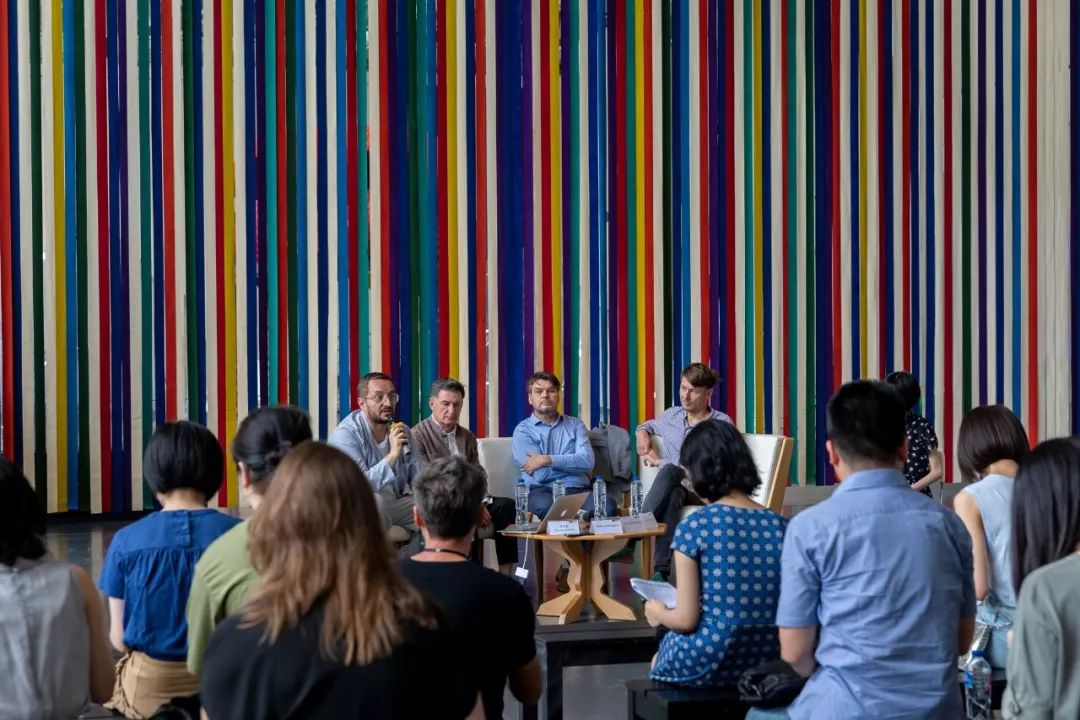
Scene view of opening talk
Davide Quadrio: Hello everyone. I am an old Shanghainese. This is my first curated exhibition at Yuz Museum, so I am really excited. The exhibition has been shown in Milan and it looked very different than the one we have at Yuz Museum. The exhibition venue in Milan was an ancient castle, an old-style building where the artworks had been displayed separately in each room, creating a sense of distance for the audiences. But the great hall of Yuz Museum is a space so huge that we took this advantage and re-design the show. A strong sense of space and architecture would be added in the show at Yuz Museum. The relationship between the works will be more vivid and interactive as well.
I have cooperated with Alcantara for nearly six years and we have been discussing how to help artists collaborate with corporation, which is a very interesting topic. To allow artists have independent creativity in creating their work, then to connect them with art organizations, this process is extremely complicated. The curator will face a great challenge withstand pressure in weighing the demands of artists and the partners. Nevertheless, we are always searching for new ways to build the culture on itself and to develop it. I have been working in Shanghai for 25 years, starting in ART LINK ART, which is located on West Huaihai Road. Back then, we were not given any budget and team support, our team spent half of the time working different jobs and the other half focusing in art. Now, the environment has certainly changed a lot in the past 20 years with more art spaces, museums and artists emerging.
In my opinion, each era has its own difficulties and demands. How to balance the relationship between artists, cultures and societies in our time, we had to search for new ways to collaborate with different organizations and corporations in finding a sustainable solution. To come up with a budget to help artists create a show independently is an important responsibility we as curators should take on and it must be done.
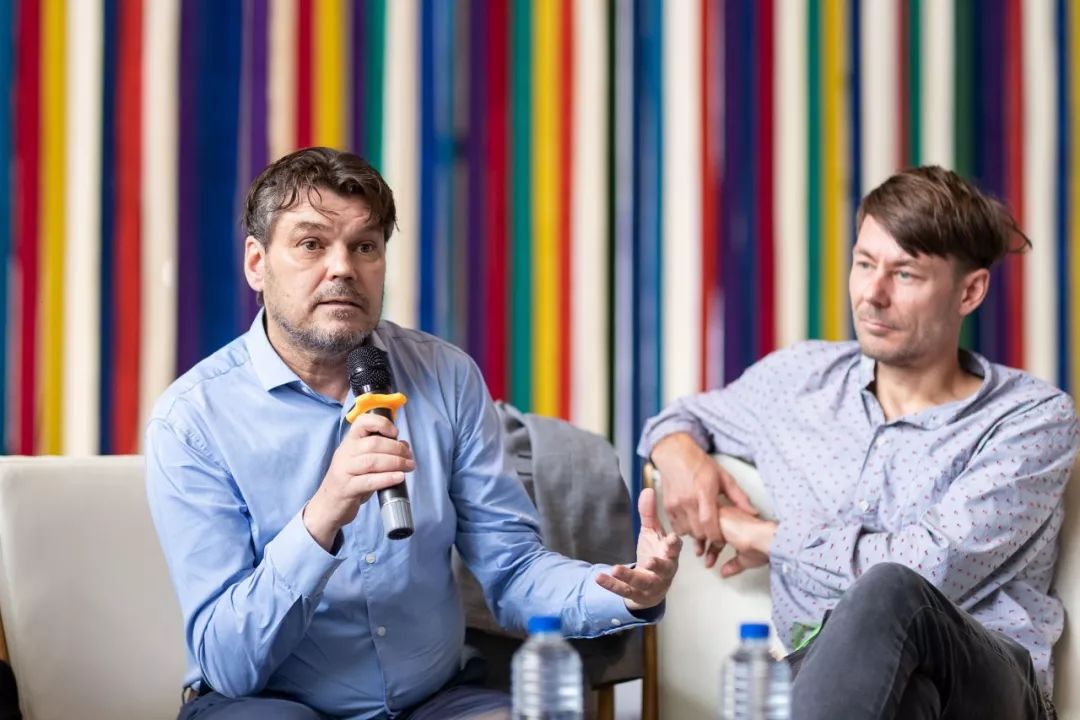
Krijn de Koning, Scene view of opening talk
Krijn de Koning: I am an artist, and I am part of this exhibition. You can find my work on your left. What I do generally is site-specific works. I make works that I am based in and I make it according to the surrounding space. You could see it is kind of a personal research, to how constricted reality has consequences of how you look at something and how you feel about something. It is beauty; it is problem. So in a way, my work is also quite architectural.
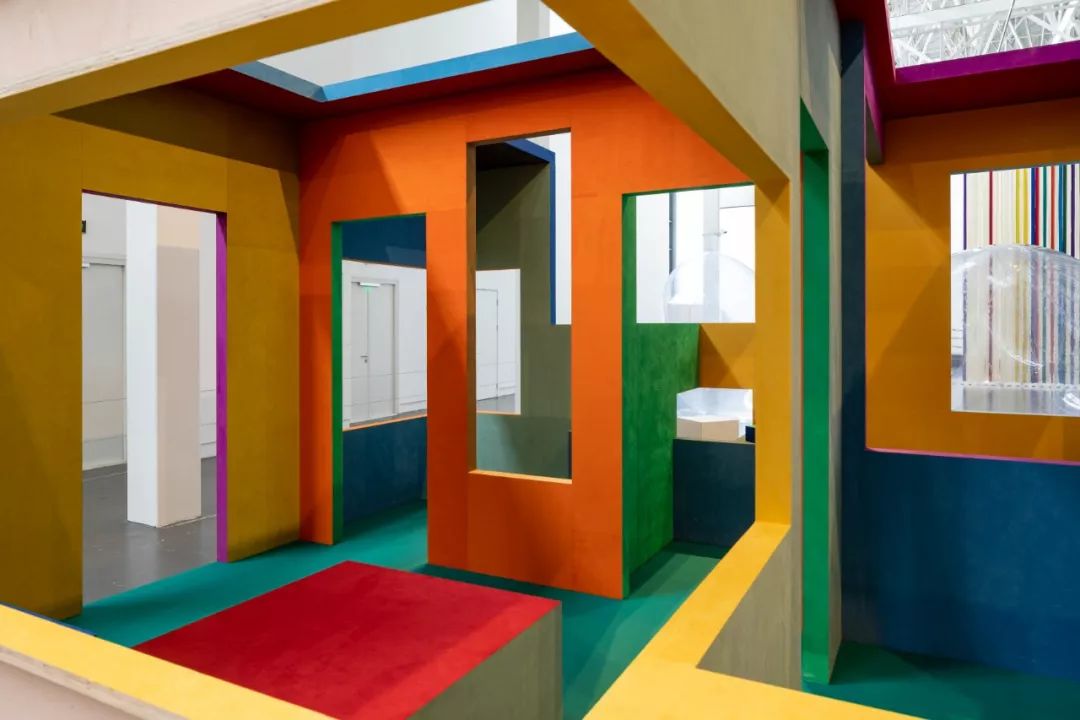
Room, Krijn de Koning
"Nine Journeys through Time", Yuz Museum, 2019
In this case, with the invitation of Alcantara, it allowed me to really do something a bit different in the sense that I made the work that is more inside-out, so it is a work that you have to go in to see it. On the inside, you have this very charged environment of colour, and it was really interesting to see how the Alcantara material, which soft quality also put the character to that space. And on the outside, you can really see it is a construction, which means you can see how it is built. You can understand that it is temporary; it is probably also flexible the way we construct the reality.
There are two versions of this work. The first work was made in a monochrome ‘blue’ with Alcantara surface. And I’m really happy to see now what would be really a more colorful treatment of this inside construction, and what it gives.
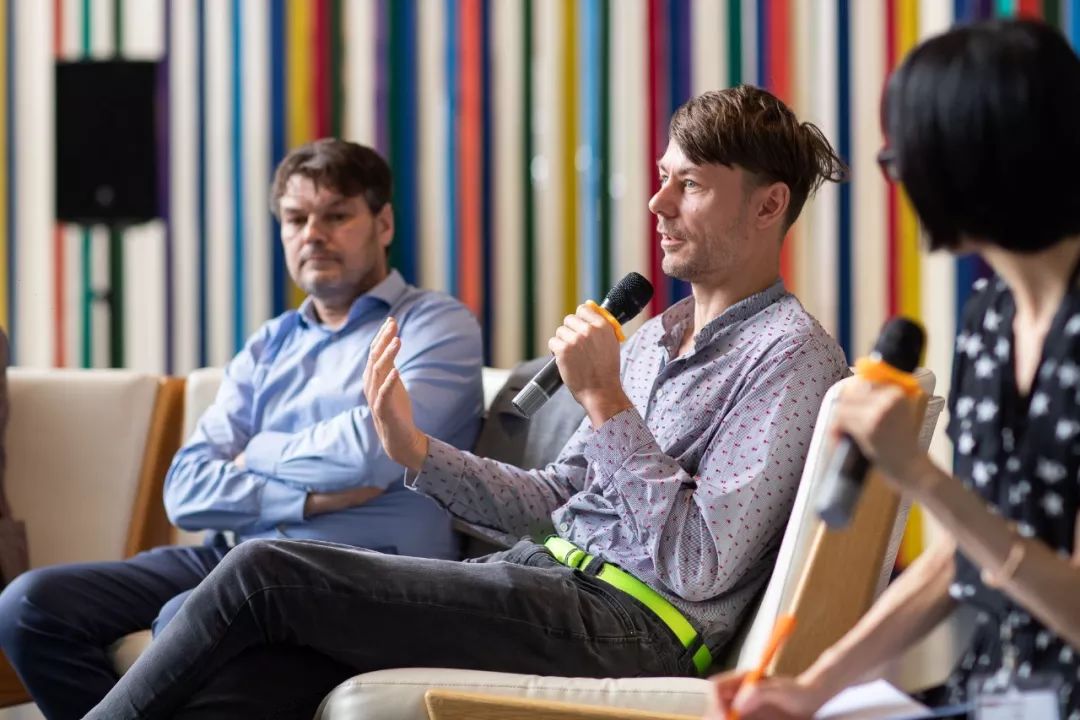
Henrik Mauler, Scene view of opening talk
Henrik Mauler: I am Henrik Mauler. I represent the artist group Zeitguised from Berlin. I am also invited to collaborate with Alcantara for this exhibition that started from Milan to Venice. I think the core of our work is also the idea of how reality is constructed. I found a citation of a Chinese philosopher who is called Zhuangzi. He put the problem in a nutshell; when he woke up from a dream about him being a butterfly, he didn’t know was he a butterfly dreaming he was Zhuangzi, or was he Zhuangzi dreaming of being a butterfly. And I think that is an early version of the problem that we work on, this kind of awareness, where illusion starts and reality ends.
And nowadays, neurophysiology and science have recognized that there is no difference in our brain between what we dream and what we perceive as a reality during the day. I think that’s something in our work, that we always try to find that sweet spot, neither reality nor something real, but it always represents a kind of a leg in both. Part of it is because we work for technology called computer of graphics. I think it’s very synthetic. It presents reality but nothing is made from something physical.
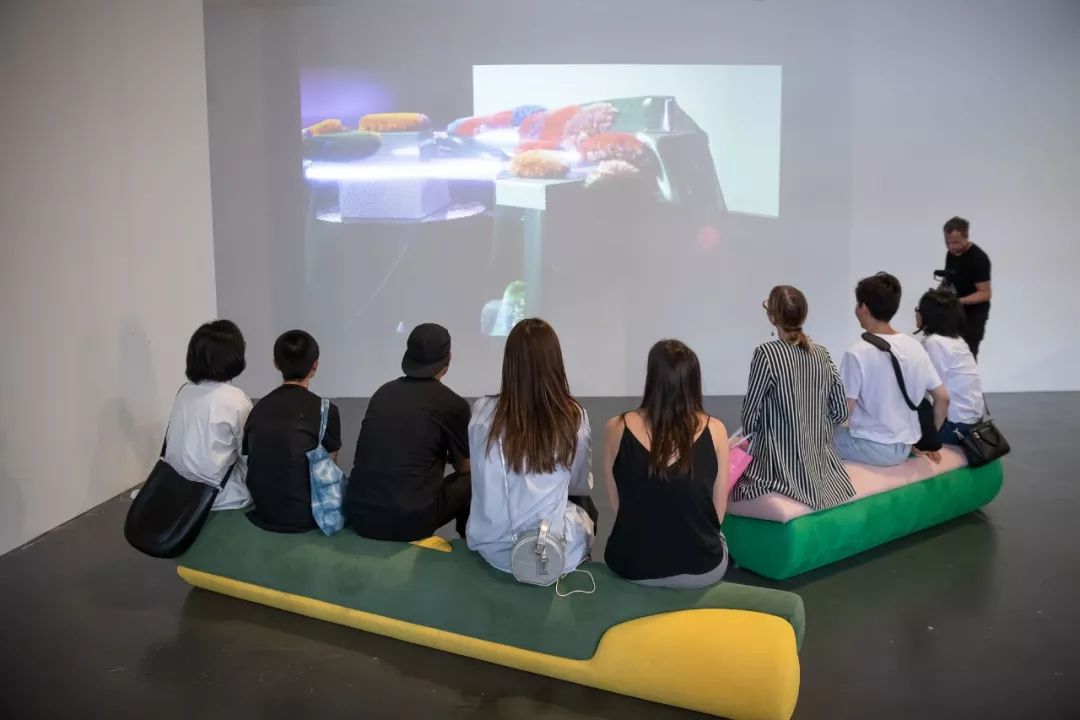
Beyond the Nuclear Garden, Zeitguised
"Nine Journeys through Time", Yuz Museum, 2019
So you are seduced to feel something real, but at the same time it’s not made of anything substantial. It’s all just data, and information. We try to work with the uncanniness of the construction, which on the one side is very poetic, you like what you see; but on the other hand, it’s very disturbing, it’s actually not based on anything. We often try to translate our poetic approach into an algorithm. So we try to make an algorithm that translates poetry, but at the same time, is visibly synthetic.
And for this exhibition, we have devised an algorithm that translates our formal language into sofa-like structures. The algorithm was putting out 200 shapes permanent. We chose some of these shapes and Alcantara used them for the exhibition. I think they were crazy enough to say yes to us. We were really lucky because they were all handmade and very complex structures. It’s easy in the algorithm, watching it.
Davide Quadrio: Yes, it was very complex. That is actually interesting when the reality and non-reality thing that comes back into reality objects, man constructed in an extremely reclined way. The result is a very simple object that doesn’t look like anything, but to make it done in the way the artist wants was extremely complicated. This kind of relationship is what people should actually see in the show, it looks very Los Angeles, but at the same time, there is a lot of work inside, and a lot of knowledge in the realization of the objects. I’d like to thank the company who worked with us to install everything and produce different works. I think they are absolutely incredible to do that, because there is also the cross-culture situation and exchange.
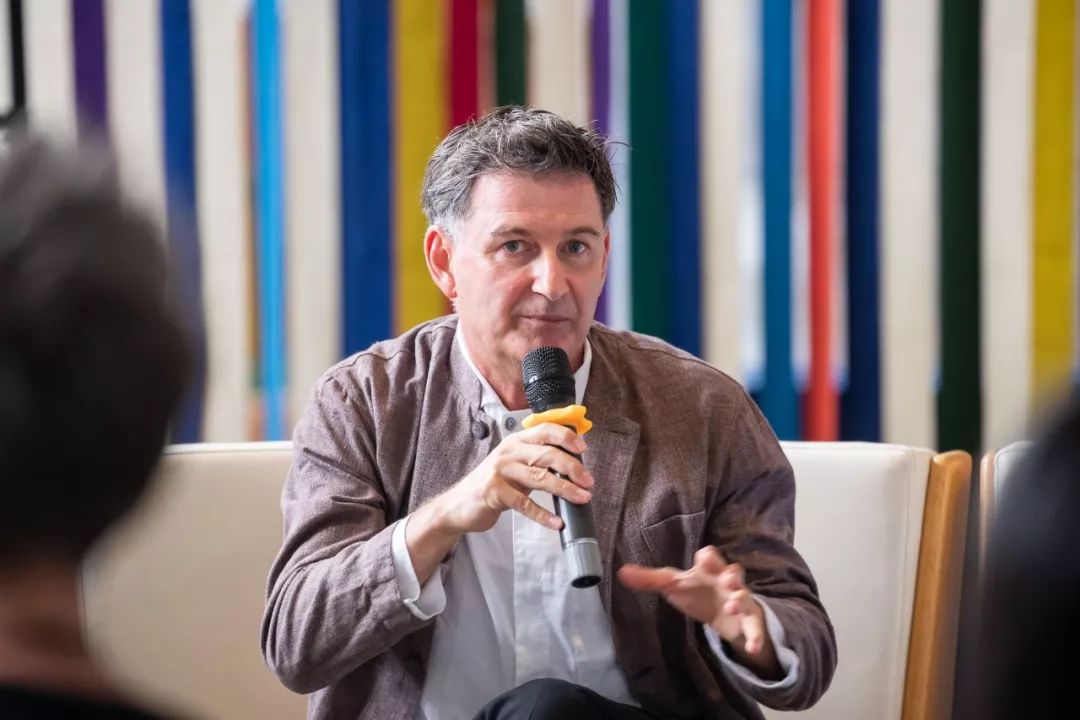
Andrea Anastasio, Scene view of opening talk
Andrea Anastasio: Hello, welcome! Thank you for being here, and I want to thank Yuz Museum and Alcantara for making this possible. Well, I’ve been trained in philosophy and I’m specialized in eastern philosophy. Then I had the chance of doing researches and ended up in a career that blends art, research and design. So I do my own independent research, focusing on subject that I think is really important to me. Occasionally I also have a project for a design company, especially when they give me the opportunity of reflecting the art research I do into proper design.
When Alcantara asked me to develop the project, immediately the first thing that came to my mind was that it was ideal to work with an artificial material that actually imitates nature. Alcantara is completely man-made, fully artificial which doesn’t exist in nature. At the same time, it has very natural touch, and it realize the touch in sensorial experience. If you don’t know it’s artificial, you actually feel it’s sweat. I wanted Alcantara to be on the real things, and that’s why I started to come to the idea of collecting trash, coming out of domestic field, working space. You will see that objects come from a typical family background, but they also come from office oriented space, and also from sport activities. What I’ve done, I mean collecting objects comes from these different fields, I asked Alcantara to develop a skin that could resemble ‘the snake skin.’
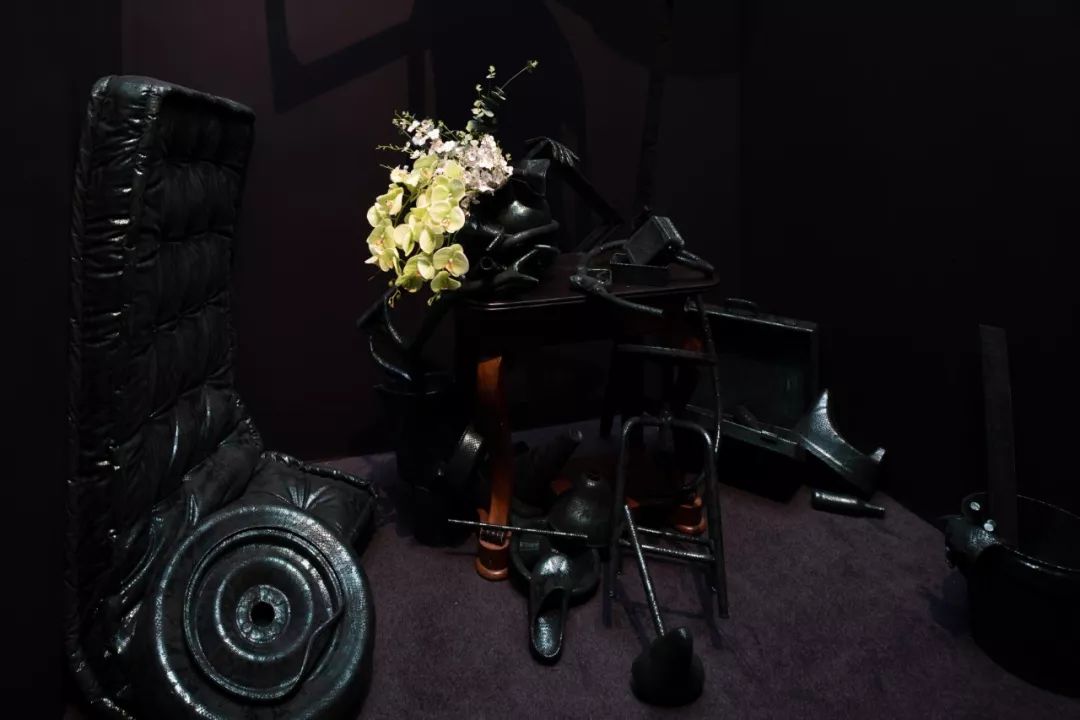
Eden,Andrea Anastasio
"Nine Journeys through Time", Yuz Museum, 2019
In many civilizations, you have myth that relies on snakes as being gods that actually are beyond the creation, that’s because they are very fast, they climb very quickly and they can reveal themselves very quickly as well. At that point, we started after Alcantara produced this amazing material that really looks like a wet snakeskin. We started wrapping the skin around found objects of the trash. The title of the work is Eden, and it really realize on these ideas using polarities and opposite to focus on one thing. In this case, the subject was very much pondering about colonizing space through objects, and the need of becoming the way and finding the way out of this intense conversation and space through objects.
The only one thing I want to say is that in Milan, it was in the royal palace, and the atmosphere was different. Here, together with Davide, we decided to give the work a slightly darker touch by building a room, which is fully black. You don’t know whether the objects are falling from the sky or they are actually going back to the sky.
Davide Quadrio: As previously said, this exhibition was designed to be an open space exhibition, but we have specially built two rooms to display two specific works of artist Andrea Anastasio, where he createda sense of darkness and lingering charm is indispensable, and of artist Iris Van Herpen’s, where it showed a piece of clothing of Iris Van Herpen that was also regard as work of sculpture. Other works all in the open space have their own unique relationship and connection with each other.
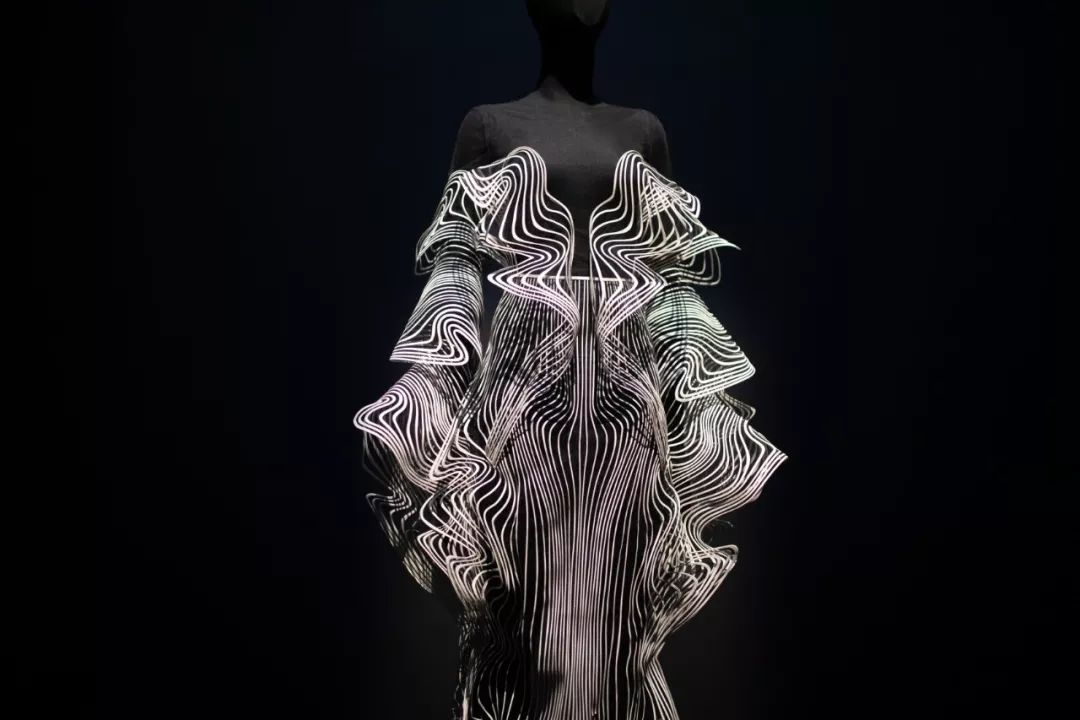
Extended Indefinitely, Iris Van Herpe
"Nine Journeys through Time", Yuz Museum, 2019
Current Exhibition
Click Image to Buy Tickets返回搜狐,查看更多