♢ 本文刊于《翻译界》2020年第2期(总第10期)第138-146页。本文版权归《翻译界》所有,转载时请注明出处。
作者简介
Tomoyuki TANAKA (田中智行) is Associate Professor in the Graduate School of Language and Culture at Osaka University. He received his PhD degree from the University of Tokyo in 2011. His research interests are Chinese classical fiction and fiction commentary. He is now working on the new translation of Jin Ping Mei ( Plum in the Golden Vase ) and published the first volume in 2018.
Email: tanaka@lang.osaka-u.ac.jp
Abstract
As a new Japanese translator of the Chinese classical novel Jin Ping Mei , in this paper, I will review some practical translation difficulties arising from translating a work belonging to a different time period, culture, and language. For instance, there is no single correct way to translate wordplays or puns. Additionally, if the original Chinese text contains certain first-person pronouns, the change of one fictional character’s tone expressed by shifting pronouns is difficult to directly reproduce in English. Arranging original expressions into new forms that are appropriate in the target language, the translator should, when possible, transmit the original feel of the text without sophistication. In a sense, translators are asked to be a conservative advocate for the target language; yet at the same time, they should also act as aggressive explorers of the target language.
Keywords: classical literature; full-length novel; Chinese-Japanese translation; Jin Ping Mei
摘 要
作为中国古典小说《金瓶梅》的日文新版译者,我将在本文中呈现在翻译属于不同时期、不同文化和不同语言的作品时遇到的实际翻译问题。例如,没有唯一正确的方法来翻译文字游戏或双关语。此外,如果原始中文文本包含某些第一人称代词,那么在英语中很难通过替换代词来再现故事人物的语调变化。在将原文表达形式转换为适合目的语的新形式时,译者应尽量简洁地传达文本的原始韵味。从某种意义上说,译者应是目的语的坚决拥护者,同时也应对其积极探索。
关键词:古典文学;长篇小说;汉日翻译;《金瓶梅》
1.
Bond with Chinese classical works — From a reader to a translator
Recently, I published the first volume translation of a Chinese classical novel. Instead of being an expert in translation studies, my knowledge on translation is practical, rather than academic. Therefore, I fear my speech will be somewhat misplaced. However, I believe the theme of translation is also open for non-experts, so I courageously decided to give this speech in front of distinguished professors in this field.
I shall begin with personal memories. The very first, complete translation of a Chinese classical novel that I read was a Japanese version of Xiyou ji 西游记 ( Journey to the West ). It was translated in the 1970s by two late professors, Ota Tatsuo and Torii Hisayasu (Ota & Torii, 1971). Ota and Torii both were famous researchers in Chinese vernacular literature. Ota was also a famous linguist, known for his books such as A Historical Grammar of Modern Chinese , published in 1957, which still maintains its value. It was reprinted posthumously in 2013 (Ota, 2013). Their translation was based on an abridged Qing edition of the novel. Not only because of the interesting story, but also because Ota and Torii’s translation style is crisp, the translation totally fascinated a ten-year-old boy living in Yokohama. Xiyou ji is one of the “Four Masterworks” of Ming novels. Thirty years later, the boy became a translator of another of the “Four Masterworks”, Jin Ping Mei 金瓶梅 ( Plum in the Golden Vase ), and is now giving a speech before you.
Although a translation of the unabridged Ming version of Xiyou ji was already completed in the 1990s, and despite the fact that I can read the original novel now, my impression of this novel till date is greatly influenced by Ota and Torii’s translation. Similarly, students of foreign literature often begin their research after being motivated by the translations of that literature in their own language. The role of translators is crucial, not only for readers, but also for future researchers.
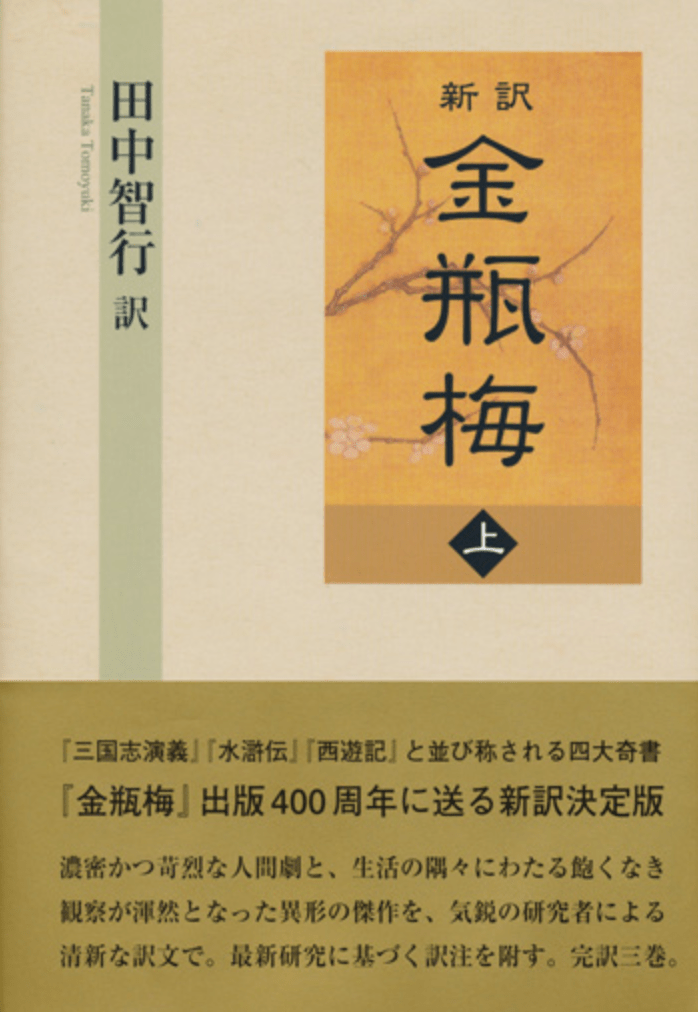
田中智行翻译的《金瓶梅》日文版
Sometimes, a good translation also inspires non-native readers of either the original or target language. As a researcher of Jin Ping Mei , I am greatly indebted to Professor David Roy’s English translation (1993-2013).
When I read Jin Ping Mei ’s Japanese translation for the first time in the 1970s, I felt that it was a very boring work elevated to a false fame only due to its erotic scenes. In fact, most “obscene” scenes are omitted without annotation in that version, but I was not aware of this at the time.
When I learned about a new English translation of this work by David Roy, I began to read it mainly for my graduate school entrance exam. The examination included readings of both English and classical vernacular Chinese, and therefore the translation was eligible for this dual purpose. Apart from being study material, the work also interested me as a piece of literature. Most notably, since my Chinese reading ability was not adequate, I felt Roy’s translation was even more stimulating than the original text.
In his introduction to the first volume, Roy declares that this work is a landmark in the development of narrative art in a world-historical context. He insists that, apart from Tale of Genji 源氏物语 and Don Quixote , there is no earlier work of prose fiction of equal sophistication. He also quotes Mikhail Bakhtin’s theoretical essay to discuss the rhetoric of this work, which I believed was very novel at that time. At the end of the introduction, Roy quotes the following moving words by David Hawkes, who is the translator of Honglou meng 红楼梦 ( Story of the Stone ), “If I can convey to the reader even a fraction of the pleasure this Chinese novel has given me, I shall not have lived in vain.” As a translator in this field, I strongly aspire to utter the same phrase with sincere sympathy.
A most remarkable virtue of Roy’s translation is his thorough research of sources. The sources have been researched for years by many scholars. In addition to quoting several poems, lyrics, and songs; the original novel includes proverbs, couplets, jokes, and even plot elements from existing works. These include, for example, dramas, short stories, and vernacular novels. Based on such research, we can understand the position of the work in the entirety of its contemporary literary spectrum.
For example, there is a poem in Chapter 20, which reads in his translation:
To sleep with every casual flower, when they number in the millions;
Is not as good a plan as going home to share a bed with your wife.
Even though, beside your pillow, she may leave something to be desired;
She will sleep with you until the morrow dawns without demanding money.
(Roy, 1993-2013, Vol. 1, p. 427)
ST: 宿尽闲花万万千,不如归去伴妻眠,虽然枕上无情趣,睡到天明不要钱。
(Lanlingxiaoxiaosheng, 1995, p. 566)
He noted that this quatrain occurs in two anthologies of excerpts from chuanqi 传奇 drama, and that in both cases the excerpts containing this quatrain appear to be from versions of the drama Xiuruji 绣襦记. Further, he pointed out that standard editions of this play do not contain the quatrain. As per my knowledge, he was the first to identify the source clearly. This discovery is also interesting, as it suggests the existence of at least one lost and more detailed edition of Xiuruji at that time.
Sometimes Roy even revised the wrong text based on its supposed original. In Chapter 29, a physiognomist surnamed Wu examines the protagonist’s wife and concubines. After having scrutinized a concubine, Wu says:
“As for this woman:
[…] One whose countenance is upright and correct,
Will be the virtuous matron of a prominent house.”
(Roy, 1993-2013, Vol. 2, p. 239)
The original text corresponding to “a prominent house” is su men 素门, which means “poor house”. When I first read these sentences comparing with the original text, I could not understand why Roy adopts such an opposite word to interpret the term, as he just notes the source without commenting on the revision. However, referring to the book of physiognomy quoted here by myself, I found that Roy, based on the source, at first revised the original text to hao men 豪门 (“prominent house”), and then translated his own revision. In my opinion, in this case, it would have been better to explain the change. Nevertheless, apparently mistaken parts of his translation are often the result of his research.
Based on such intertextuality, we can also understand the underlying meaning of the text. Here, I will adduce another translator’s example. There is a sentence in Chapter 14 of Roy’s Jin Ping Mei that reads: “Even if I were made of iron, how many nails could you get out of me?” 浑身是铁,打得多少钉儿?(Roy, 1993-2013, Vol. 1, p. 282). In this context, it expresses the limits of one’s capacity. A similar expression occurs in Chapter 32 of Xiyou ji , but the context is slightly ambiguous there. As a result, a certain Japanese translator (not Ota and Torii) misunderstood the meaning and translated the second phrase as “you can get many nails”. The translator overlooked the roughly contemporary example in Jin Ping Mei , and as a result, the meaning became the very reverse. In translating a full-length novel, some mistakes are almost inevitable, but careful research will certainly reduce them.
Another virtue of Roy is his consistency in wording. He states in his introduction:
Since I believe that these repetitious elements are not fortuitous, but part of the author’s conscious artistry, I have striven, to the extent possible, to render all such passages in exactly the same way whenever they occur or recur. Occasionally this may produce a slight awkwardness in English, but I hope that the reader will put up with this flaw in order to better appreciate one of the salient features of the text.
(Roy, 1993-2013, Vol. 1, p. xlviii)
He translates every repetition very faithfully to the original text, and this translating attitude contributes much to reproducing the character of the Chinese text. For example, there are many repetitions of the term zhijian 只见 when introducing a character who has newly arrived in a scene. Roy basically translates the word as “who should appear at this juncture but [someone]” or “whom should they see but [someone]”. The frequent use of such translations may be a little verbose for normal English style, especially as the original word itself is a kind of fixed expression. Nevertheless, we should admit that they also successfully reproduce a kind of the original taste and rhythm. Frankly, in my own translation, I attempt to imitate this tactic, but for the term zhijian 只见, I gave up on applying only a single Japanese word as that sounded too unnatural in my language.
Another example of Roy’s technique for translating recurrent words is taken from chapters 1 and 20. There are two depictions of snow in the original text.
Ch.1: 只见四下彤云密布,又早纷纷扬扬,飞下一天瑞雪来。
(Lanlingxiaoxiaosheng, 1995, p. 18)
Ch.20: 只见天上彤云密布,又早纷纷扬扬,飘下一天雪花儿来。
(Lanlingxiaoxiaosheng, 1995, p. 563)
It is not easy to notice that the two depictions are very similar, as they are separated by some text, and the depictions themselves do not stand out. However, according to Zhang Zhupo 张竹坡, an influential classical commentator on this novel, such repetition is often based on intentional design over the entire novel, so translations should echo each other. Roy does not annotate this repetition, but his translations are ideal.
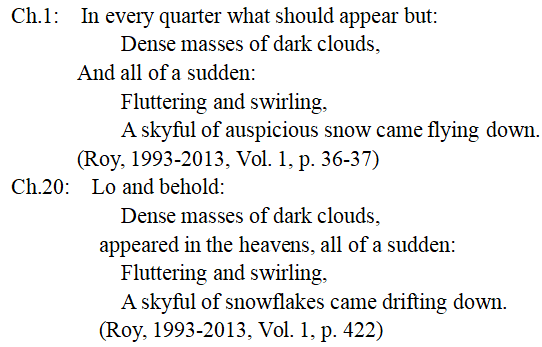
He not only noticed this similarity, but also tried to reproduce it. He also slightly changed nearby words such as “auspicious snow” into “snowflakes”, and “flying down” into “drifting down” to reflect the subtle differences between the two depictions; such an unnoticed but invaluable effort is seen almost everywhere in his translation. This, I believe, is the work of a true translator.
Although not at par with Roy, as a translator of the new Japanese translation (of which only the first of three volumes was published), I also attempted to introduce novel practices in my own effort. First, affected by Roy’s translation, I tried to translate everything. For example, as much as possible, I translated jokes and puns in the Chinese original into jokes and puns in Japanese translation. For instance, in Chapter 12, there is a joke mocking a madam in the licensed quarter. After being treated badly, a mason, who was commissioned to repave the courtyard, stuck a brick in the madam’s drain and made her courtyard fill with water. The madam changed her attitude toward him, and he removed the brick from the drain. Asked by the madam what was the problem, he replied, in Roy’s translation:
The problem with your drain was the same as it is with you:
It’s only dough that makes things flow;
Without the dough, there’d be no flow.
(Roy, 1993-2013, Vol. 1, p. 229)
The coupled phrase in the original is: you qian bian liu, wu qian bu liu 有钱便流, 无钱不流. Here, the verb liu 流 (to flow) is a pun with liu 留 (to detain someone), and therefore, this joke becomes a sarcastic criticism of the madam, who only detains the guests who have money. I translated the verb into a verb, hiku 引く, which has the meanings of “to recede” and “to tout”.
I also placed illustrations in footnotes to help readers interpret unfamiliar clothing accessories, musical instruments, and so on. In footnotes, I quoted the classical comments of Ming and Qing Period to introduce classical understandings of the text. On the source research, my contribution is limited. However, I found that the opening poem in Chapter 37 is, with some textual variation, originally the work by Li Yu 李煜, the last ruler of the Southern Tang state. The poem reads, in Roy’s translation:
Time passes languidly abroad the light vessels on the waterways of Wu;
Parting cups were refilled and you indulgently supported my unsteady gait.
On the blue sea you may be assailed by sorrow as light flickers lambently;
Among scattered peaks I can hardly object to the colors of divergent shades.
As you are propelled forward by your orchid oars how full are your feelings;
While I am reduced to leaning on the balustrade as the sun sets in the west.
Amid misty waves, so near and yet so far, how vast is the distance between us;
There is no need for you to harbor in your breast a sense of redoubled sadness.
(Roy, 1993-2013, Vol. 2, p. 360)
ST:吴 𦨻轻舸更迟迟,别酒重斟惜醉携,沧海侵愁光荡漾,乱山那恨色高低;
君驰蕙揖情何极,我恣阑干日向西,咫尺烟波几多地,不须怀抱重萋萋。
(Lanlingxiaoxiaosheng, 1995, p. 996)
A certain Chinese researcher interpreted this to be a poem depicting the sentiment of a wife far away from her husband; that researcher found no appropriate reason why this poem should be placed at the top of Chapter 37, as there is no such story in the chapter. However, as the original poem is written to see off Li Yu’s young brother, who is going to his new post, the author must quote it, because it is appropriate to put after the parting scene depicted at the end of Chapter 36, in which two male guests say farewell to the protagonist of the novel, Ximen Qing 西门庆. With the aid of electronic databases, such research will continue to make progress hereafter.
全文未完,读者可点击下方链接,获取原文。
美 编
审 校
李思慧
蒋剑峰返回搜狐,查看更多